Brand New or Resale: Which Is Right for You?
“New” versus “resale” is one of the most common home-buying comparisons, and it’s often oversimplified.
Both options can work well. Both can come with surprises.
This post is information-only. No opinions, no pressure. Just a practical comparison, plus what to check in any home before you commit.
First, define what “new” and “resale” actually mean
Brand new usually means the home has never been lived in. This can include pre-construction or recently completed builds.
Resale simply means the home has been lived in before. That could be a 1 to 2 year old home that still feels brand new,
or it could be a century home with original details. Resale is a category, not an age.
At-a-Glance Comparison
| Consideration | Brand New Home | Resale Home (including newer resale) |
|---|---|---|
| Condition on day one | Typically less wear and tear, but deficiencies can still exist | Depends on how the home was lived in and maintained |
| Warranties and formal protections (Ontario) | Covered by Ontario’s new home warranty program administered by Tarion, with specific timelines for claims (Tarion warranty overview, forms and timelines) |
No equivalent “new home” warranty as a default. Protection is typically what you negotiate (inspection, representations, insurance). Some newer resale homes may still have remaining warranty coverage depending on the home and documentation. |
| Builder reputation and registration (Ontario) | Builder and seller must be licensed in Ontario and can be checked in the Ontario Builder Directory (Ontario Builder Directory; HCRA) |
Not applicable in the same way, but you can review permits for major work and ask about renovation history |
| Energy efficiency | Often higher efficiency materials and tighter building envelope (in theory) | Ranges widely; newer resale may be comparable, older homes may need upgrades |
| Smart home readiness and modern tech | Some new builds are designed to be “smart home ready” with structured wiring, better Wi-Fi planning, smart thermostats, smart doorbells, and integrated security options (features vary by builder and package) |
Newer resale may already include smart devices. Older homes can be upgraded, but you may need added wiring, better electrical capacity, mesh Wi-Fi, and occasional panel or circuit work |
| EV charging readiness | More likely to have higher electrical capacity, but EV rough-ins are not universal and may be an upgrade | Newer resale may already have a rough-in or charger. Older homes may need a panel upgrade and dedicated circuit |
| Accessibility and “future-proofing” options | Some new builds offer design options such as wider doorways, step-free entries, lever handles, reachable switches, and better lighting plans (availability varies by builder and model) |
Possible through renovation, but it can involve structural changes (door widening, bathroom reconfiguration, ramps, lighting upgrades) |
| Neighbourhood and lifestyle | Developing community; ongoing construction and incomplete amenities are possible | Established streets, mature trees, proven traffic patterns and amenities |
| Customisation | Limited unless purchased early enough to choose options; upgrades can add up | More flexibility through renovation, but timelines and costs vary |
| Move-in timing | Construction schedules can change; delays happen | Possession dates are usually known and more predictable |
Brand New Homes: What to Consider
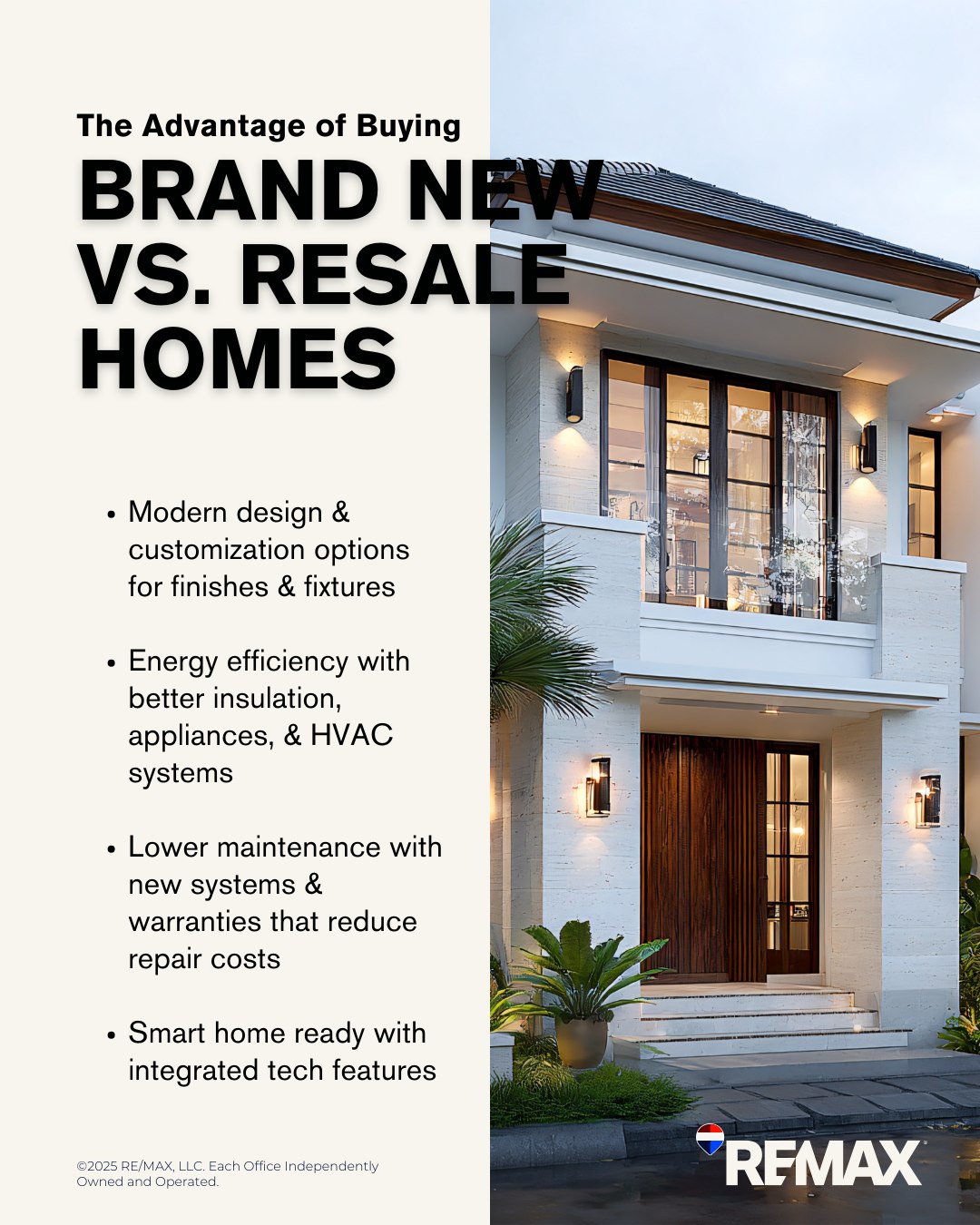 What “new” can do well
- New mechanical systems, wiring, plumbing, windows, and insulation
- Often better energy performance compared to older housing stock
- Layouts that suit modern living (storage, mudrooms, open common areas)
- In some developments: smart home readiness (structured wiring, smart thermostat capability, doorbell and security integrations),
depending on builder and package - Potential “future-proofing” options in some models: wider hallways/doorways, improved lighting plans, reachable switches,
step-free entries (options and standards vary) - Formal warranty structure in Ontario (Tarion) with defined claim periods
What “new” does not guarantee
- No guarantee of perfection: workmanship issues and installation errors still happen
- Homes settle; small cracks, nail pops, and adjustments are common early on
- Finishing items may be incomplete at possession (grading, driveway, sod, fencing), or they may be extra cost
- Surrounding construction can mean noise, dust, traffic, and changing streetscapes for months or years
- Some “smart home” features may require subscriptions, add-ons, or upgrades to work as expected
Ontario notes: Tarion and deposit protection timelines
In Ontario, the new home warranty program is administered by Tarion. Warranty coverage after possession is commonly organized into
1 year, 2 year, and 7 year periods depending on the issue
(Tarion overview;
coverage outline).
Tarion also publishes claim forms and timelines, including exceptions
(claim forms and timelines).
If you are buying a new build, read the current Tarion information directly and follow their process, especially around registration and timelines
(registration guidance;
pre-possession coverage).
Builder reputation and registration (Ontario)
In Ontario, new home builders and sellers must be licensed by the Home Construction Regulatory Authority (HCRA).
You can verify a builder’s licence status and review details using the Ontario Builder Directory
(Ontario Builder Directory;
what the directory shows).
What to look for in brand new homes (yes, plumbing still matters)
- Plumbing installation quality: leaks under sinks, inconsistent pressure, slow drains, loose fixtures, noisy pipes
- Grading and drainage: slope away from the foundation; downspouts discharge away from the home
- Windows and doors: smooth operation, proper sealing, no drafts or visible gaps
- Ventilation: bathroom and kitchen exhaust that actually vents effectively
- Electrical capacity: panel size, available breaker space, number of circuits for modern usage
- EV readiness: is there a garage rough-in, and can the panel support a charger if needed
- Smart home readiness: is there structured wiring, are there logical access points, and is Wi-Fi coverage practical
across the layout - Accessibility options (if relevant for your household): doorway widths, step-free entry routes, lighting placement,
reachable switches, lever handles, and bathroom layouts that allow safe movement - Independent inspection: consider inspections where permitted, and document deficiencies early
Resale Homes: What to Consider
Resale can mean “nearly new” or “truly old”
A resale home could be 1 to 2 years old with modern systems and strong efficiency. It could also be decades older with upgrades completed over time.
The category is broad, so the best approach is to evaluate the specific property, not the label.
What resale can do well
- Established neighbourhoods and mature landscaping
- Proven “how it lives” reality: noise patterns, traffic flow, daylight, seasonal drainage
- Character and charm that many buyers value (architectural detail, lot shape, mature trees)
- Renovations and improvements may already be completed, saving time and disruption
- Possession timing can be more predictable than construction schedules
What to look for in older resale homes
- Electrical: panel capacity, wiring type, evidence of overheating, grounded outlets, GFCI where appropriate
- Plumbing: pipe material, water pressure, drainage speed, evidence of leaks or past water events
- Foundation and structure: major cracks, moisture intrusion, uneven floors, sticking doors
- Roof and attic: age, insulation levels, signs of past leaks, ventilation
- Heating and cooling: age and service history of furnace, AC, heat pump, hot water tank
- Moisture and ventilation: musty odours, staining, condensation patterns, bathroom fan performance
What to look for in newer resale homes (including 1 to 5 years old)
- Warranty status: confirm what coverage remains and what documentation exists, if any
- Builder repair history: ask what was addressed after closing and what remains outstanding
- Plumbing and finishing wear: even a newer home can have leaks, poor caulking, or settling-related issues
- Smart home devices: confirm what stays, what requires accounts or subscriptions, and whether it is properly set up
- EV and future loads: confirm panel capacity and whether a dedicated circuit exists or is feasible
- Connectivity: confirm Wi-Fi performance in key areas and whether hardwiring is available where you need it
Resale homes can offer charm and established settings, and newer resale can offer many of the benefits of a new build without the construction timeline.
The point is the same either way: evaluate the actual home, not the label.
How to Decide Without Guessing
Instead of asking “Which is better?”, these questions tend to produce clearer decisions:
- How long do I plan to stay?
- Do I want predictable near-term maintenance, or am I comfortable taking on upgrades?
- How much disruption can I handle: construction timelines, renovations, or both?
- Do I value established neighbourhoods and mature lots, or a clean start and modern efficiency?
- What is my budget for the “after purchase” reality: upgrades, repairs, landscaping, tools, and time?
- Do accessibility or mobility needs matter now, or could they matter later?
- Do I want tech-ready convenience (smart systems, EV charging readiness), or am I fine retrofitting over time?
Quick Checklist Before You Commit
- Get a home inspection that matches the property type (new build and resale both benefit)
- Review insurance availability and cost (some construction types and system ages affect premiums)
- Confirm permit history if major work has been done (structural, plumbing, electrical, additions)
- If buying new in Ontario: verify the builder is licensed (HCRA) and understand Tarion timelines and registration steps
- Budget for the non-negotiables: window coverings, fencing, landscaping, appliances, EV charger install if needed
- Confirm what smart devices stay with the home, and whether they require accounts, subscriptions, or transfers
- If accessibility matters: measure doorway widths, evaluate entry steps, lighting placement, and bathroom layouts early