Stories about tenants being asked to leave because a buyer says family members will move in raise important questions about housing stability, tenant protections, and real estate due diligence in Ontario.
The key issue is the sixplex.
Under Ontario’s N12 rules, a seller serving an N12 on behalf of a purchaser is generally limited to a residential complex with no more than three residential units, or a condominium unit. That is why a six-unit building should raise immediate legal review before anyone assumes vacant possession is available.
For tenants, landlords, buyers, sellers, and investors, the main point is simple: an N12 notice is not the same as an automatic eviction.
What Is an N12 Notice?
An N12 is a notice to end a tenancy because the landlord, purchaser, qualifying family member, or caregiver requires the rental unit for personal residential use.
It is the first step in the process. If the tenant does not move out, the landlord must apply to the Landlord and Tenant Board, commonly called the LTB. The LTB then decides whether to grant an eviction order.
Tenants have the right to challenge an N12 notice. They may ask the LTB to review whether the notice was served properly, whether the required compensation was paid, and whether the stated intention appears to be made in good faith.
You can review the official Ontario Landlord and Tenant Board N12 form here:
N12: Notice to End your Tenancy Because the Landlord, a Purchaser or a Family Member Requires the Rental Unit
Why a Sixplex Is Different
One of the most common areas of confusion involves multi-unit buildings.
Ontario’s N12 rules include specific limits when a seller serves an N12 on behalf of a purchaser. For purchaser-use situations, the rule generally applies to a residential complex containing no more than three residential units, or to a condominium unit.
That distinction matters.
A duplex or triplex may be reviewed differently than a fourplex, sixplex, apartment building, or larger multi-unit property. A buyer, seller, or investor should not assume that vacant possession is available simply because a purchaser says family members intend to move in.
This is especially important when multiple tenants may be affected, when the building is income-producing, or when vacant possession is being relied on as part of the purchase strategy.
What the Toronto Case Raised
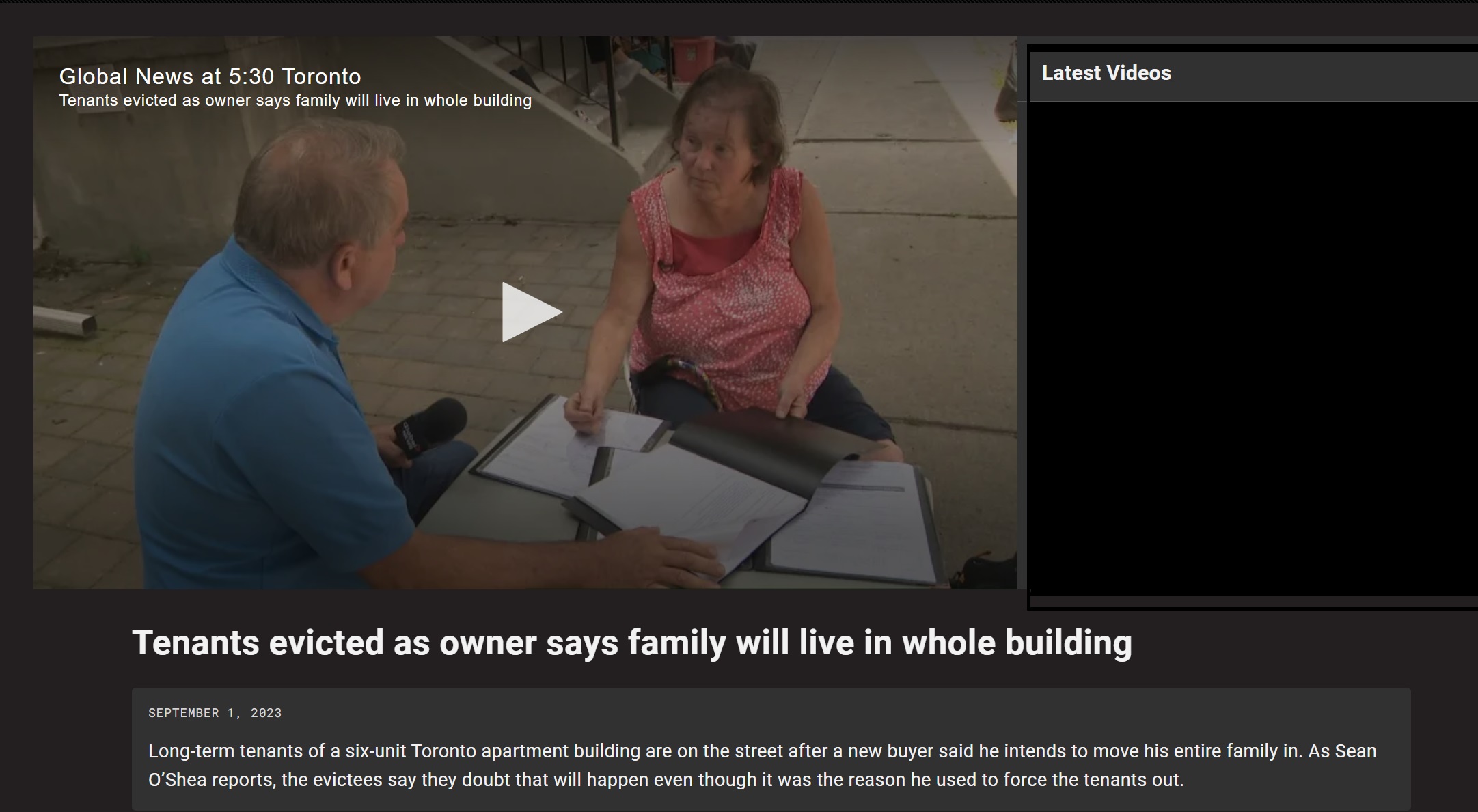
A reported Toronto case involved long-term tenants in a six-unit apartment building who were displaced after a new buyer said his family intended to live in the property.
The story drew attention because tenant advocates questioned how family-use eviction rules were being applied in a larger multi-unit building.
Cases like this show why buyers and sellers need proper legal advice before relying on vacant possession, purchaser-use notices, or assumptions about removing tenants after a sale.
They also show why tenants should not assume that receiving a notice means they must leave without understanding their rights.
Click the image below to view the Global News video article and interview.
Tenant Protections Matter
Ontario rental law is designed to balance property ownership rights with tenant stability. That balance matters because housing is not only a financial asset. It is also someone’s home.
For tenants, an N12 notice should be reviewed carefully. Tenants may have the right to remain in the unit until the LTB makes a decision.
Tenants may also have remedies if the notice was given in bad faith or if the unit is not used as stated after they move out.
For landlords and buyers, the process requires accuracy, documentation, and good faith. Mistakes can lead to delays, disputes, financial consequences, and reputational harm.
Compensation and Timing
The N12 process also includes timing and compensation requirements.
In many N12 situations, the termination date must generally give at least 60 days’ notice. The landlord must also provide the required compensation, which is usually equal to one month’s rent, or offer another rental unit acceptable to the tenant.
These details matter. If the timing, compensation, service method, or stated reason is not handled properly, the notice may create problems at the LTB.
What Buyers and Investors Should Review Before Purchasing
Buying a tenanted property in Ontario requires more than reviewing the purchase price and rent roll. Investors and buyers should understand the legal status of every tenancy before making assumptions about use, possession, or future income.
Before buying a tenanted property, review:
- the number of residential units in the property
- current leases and tenancy terms
- rent amounts and deposits
- whether tenants are month-to-month or in fixed terms
- which units are occupied or vacant
- whether vacant possession is realistic or legally supported
- whether any notices have already been served
- whether legal advice is needed before conditions are waived
Why This Matters in Ontario Real Estate
Ontario’s rental market is under pressure. Tenants are facing affordability challenges, limited supply, and uncertainty. At the same time, landlords and investors are dealing with rising costs, financing pressure, repairs, regulation, and changing market conditions.
That tension makes proper process even more important.
For tenants, knowing their rights can prevent unnecessary displacement. For buyers and investors, understanding the rules can prevent costly mistakes. For sellers, clear disclosure and careful documentation can reduce complications during a transaction.
The Bottom Line
An N12 notice is a serious legal step. It should not be treated as a shortcut to vacant possession or a casual strategy for repositioning a rental property.
In a sixplex or larger multi-unit building, the issue becomes even more important. Buyers, sellers, landlords, and tenants should get qualified legal advice before relying on a purchaser-use N12, vacant possession, or family-use occupancy claim.
If you are a tenant, seek qualified legal or paralegal advice before making decisions based on a notice. If you are a buyer, seller, landlord, or investor, review the rules carefully before relying on family-use occupancy, vacant possession, or rental property assumptions.
With decades of investor-level real estate experience, The Murree Group | MovingSimcoe.com Team helps clients approach real estate investing with clarity, structure, and long-term strategy.
For confidential real estate guidance, connect with us or schedule a confidential conversation.
Related Resources
If you are weighing your options, this related resource may help:
Buying vs Renting in Simcoe County
Disclaimer: This article is for general information only and does not constitute legal advice. Ontario rental rules can be fact-specific. Tenants, landlords, buyers, and sellers should speak with a qualified lawyer or licensed paralegal before making legal decisions.