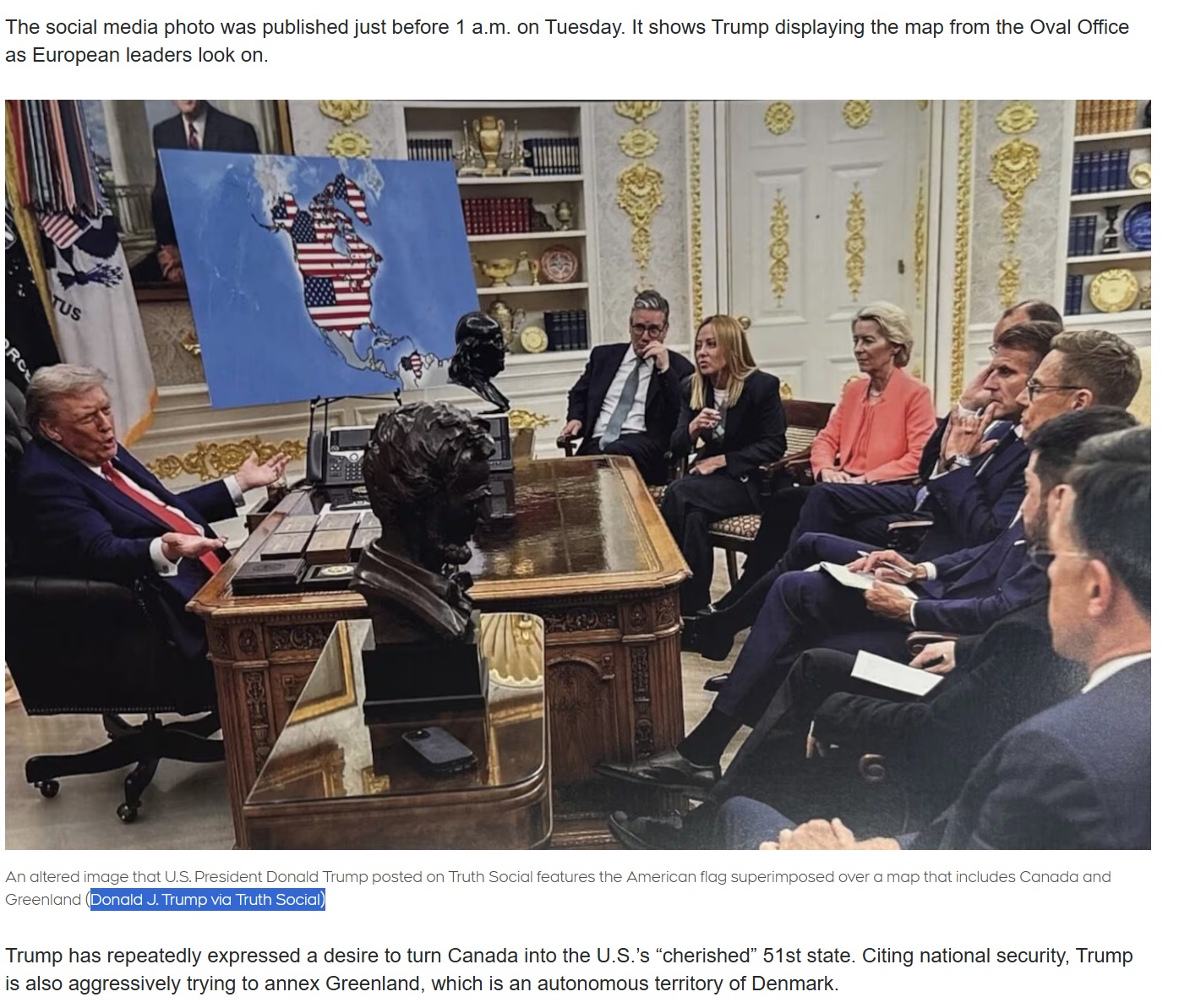
In a late-night post to his Truth Social platform, U.S. President Donald Trump shared an altered image depicting the American flag superimposed across large portions of North and South America, including Canada, Greenland and Venezuela.
The post was published just before 1 a.m. Tuesday. It shows Trump holding a map inside the Oval Office while European leaders appear to look on.
It is an altered photo of an official White House image
It is important to note that this image is not original.
The photo is a modified version of an official White House image taken on August 18, 2025, which shows President Trump meeting with European leaders in the Oval Office around a map of Ukraine. That original, unaltered photograph was released by the White House and credited to Daniel Torok.
In the version posted to Truth Social, the map was digitally changed to display the U.S. flag covering much of the Western Hemisphere.
 Context behind the messaging
Trump has repeatedly made comments about Canada becoming a “51st state” and has continued to frame Greenland, an autonomous territory within the Kingdom of Denmark, as a national security priority. Canada, Denmark and the United States are all members of NATO, and both Ottawa and Copenhagen have publicly pushed back against this expansionist rhetoric.
The timing of the post also coincides with heightened U.S. attention on Venezuela, particularly its oil industry and geopolitical alignment.
This imagery aligns with the Trump administration’s updated U.S. National Security Strategy, released in late 2025, which emphasizes restoring American dominance in the Western Hemisphere and asserting greater influence across the region.
A moment to pause and think
Images like this raise questions beyond politics.
- How do Canadians see themselves in relation to the United States?
- What does national identity actually mean in a world where economic ties, defence alliances and digital messaging blur borders?
- If you had to choose, what defines you more: being Canadian, being North American, or simply being where you live and build your life?
For those of us focused on housing, community and long-term stability, these moments are reminders that geography, policy and perception all shape how countries, and people, relate to one another.
Does Canada need to push back?
Yes, but carefully and deliberately.
Silence gets interpreted as consent. When altered imagery, annexation language, or “51st state” framing goes unchallenged, it normalises the idea that Canada’s sovereignty is negotiable. That matters, even if no policy change follows immediately.
Pushing back is not about escalation. It is about setting boundaries.
What effective pushback should look like
Not chest-thumping. Not social media outrage. Not symbolic retaliation.
Effective pushback is boring, disciplined, and institutional:
- Clear diplomatic statements reaffirming sovereignty
- Alignment with allies, especially through NATO and multilateral forums
- Consistent messaging that Canada is a partner, not a subordinate
- Quiet reinforcement of economic and defence autonomy where it actually counts
This approach protects credibility without feeding provocation.
What pushback should not be
- Emotional responses
- Tit-for-tat rhetoric
- Playing to domestic outrage cycles
- Turning geopolitical signalling into partisan theatre
That weakens Canada’s position and hands control of the narrative to someone else.
The real issue underneath
This is less about liking or disliking the U.S., and more about how power signals are tested. Strong countries probe boundaries. Serious countries respond with clarity, not volume.
Canada’s strength has always been stability, legitimacy, and predictability. The pushback should reflect that.
Bottom line: Canada should respond, but in a way that reinforces sovereignty through institutions and alliances, not noise.
Also read…When Urgency Drives the Decision Instead of the Strategy