Barrie Annexation and Real Estate: Follow the Money Trail Behind Land, Growth and Value
Municipal boundary changes can reshape real estate long before new homes, roads or buildings appear.
Barrie’s annexation of lands from Springwater and Oro-Medonte is a strong local example of how land value, servicing, housing supply and investor interest can shift when rural or township land becomes part of a growing city.
But to understand what is really happening, you have to follow the money.
Developers, corporations and long-time landowners do not spend millions of dollars on borderland by accident. They watch planning signals, servicing capacity, political direction, population growth and future development potential. When those signals start lining up, land that once looked rural can quickly become strategic.
For buyers, sellers, investors and residents, the key issue is not only who owns the land today. It is what the land may become, who can service it, how it may be planned, and how future development could affect property values across the surrounding area.
In real estate, boundary changes influence value because they can change access, infrastructure, servicing and future use.
The Money Trail Behind Barrie’s Growth
Land ownership tells a story.
When developers, numbered companies, institutional buyers and long-term landholders start showing up around a future growth area, it is rarely random. It often means the market is pricing in future potential before the public fully sees it.
In the case of Barrie’s annexation, reported land transactions show millions of dollars moving into properties along or near Barrie’s border before and around the municipal boundary change.
Land value does not only rise when homes are built.
Value can begin shifting when:
- A boundary change is discussed
- Servicing becomes more likely
- Planning policy starts changing
- Developers begin assembling land
- Institutional buyers purchase nearby parcels
- Properties are marketed as future development opportunities
- The market believes urban uses may become possible
The public may still see fields, golf courses, rural roads or older properties.
The market may already see future housing, employment lands, commercial uses, institutional expansion or mixed-use development.
What Happened With the Barrie Annexation?
Barrie’s boundary changed through provincial legislation, bringing certain lands from Springwater and Oro-Medonte into the City of Barrie.
That boundary change can alter how land is viewed, valued and planned.
Land inside a growing city boundary can have a very different future than land outside it, especially when the city has greater capacity to provide water, wastewater and other services needed for development.
Before annexation, some properties may have been viewed mainly as rural, agricultural or long-term speculative land. After annexation, those same properties may be viewed through a different lens: future housing, employment lands, commercial space, mixed-use development, institutional use or other urban growth opportunities.
That shift can create major value changes.
Following the Reported Sales and Listings
Several reported transactions and listings show why the annexation is important from a real estate value perspective.
- Sean Mason’s companies reportedly spent nearly $19 million buying two large properties in the annexation area.
- A numbered company reportedly purchased land on Anne Street North for $6,596,000.
- Yorkwood Homes reportedly spent $6 million in 2018 on land near Sunnidale Road and Wilson Drive.
- The New Barrie Group reportedly purchased land at 384 Penetanguishene Road for $1.5 million in 2021 and sold it to Royal Victoria Regional Health Centre for $6 million shortly after the annexation.
- Royal Victoria Regional Health Centre also purchased 366 Penetanguishene Road and 0 Georgian Drive from Georgian Drive Developments, with an $8 million vendor take-back mortgage reported.
- 700 Line 1 South, reportedly purchased for $75,000 in 1996, has been listed for $7.5 million and marketed as investment land now within Barrie’s boundaries.
- 424 Penetanguishene Road, home of the Landings of Willow Creek Golf Course, reportedly purchased for $875,000 in 2019, has been listed for $5.5 million and promoted as a development or business relocation opportunity.
- 651 Bayfield Street North was reportedly purchased by Sean Mason for $3 million in 2023, in the Bayfield Street corridor near lands expected to benefit from cross-border servicing discussions.
Those numbers are not just trivia.
They show how the market responds when land may shift from rural or limited-use potential into a future urban growth conversation.
The 384 Penetanguishene Road Example
The reported sale of 384 Penetanguishene Road is one of the clearest examples of how value can change when future use, location and timing come together.
The property was reportedly purchased by the New Barrie Group for $1.5 million in 2021. It was later sold to Royal Victoria Regional Health Centre for $6 million shortly after the annexation.
That is a $4.5 million difference between the reported purchase price and sale price.
This does not mean every annexed property will see that kind of increase. It does show why strategic land buyers watch boundary changes, institutional expansion and servicing potential closely.
When a property moves from being simply land to being land with a more likely future use, its value can change significantly.
The 700 Line 1 South Example
Another strong example is 700 Line 1 South.
The property was reportedly purchased for $75,000 in 1996 and later listed for $7.5 million after becoming part of the City of Barrie boundaries.
That listing price reflects more than the original use of the land. It reflects anticipated future potential.
The value being marketed is not only what the land is today. It is what the land may become if planning, servicing and development approvals line up.
That is the heart of speculative land value.
The 424 Penetanguishene Road Example
The Landings of Willow Creek Golf Course at 424 Penetanguishene Road was reportedly purchased for $875,000 in 2019 and later listed for $5.5 million.
The listing reportedly highlighted its new status within the City of Barrie and positioned the property as an investment opportunity for development or business relocation.
That shows how annexation can change the way a property is marketed.
A golf course, rural property or large parcel may still physically look the same. But if its municipal context changes, its potential buyer pool can change too.
A future developer, commercial user or land investor may value it differently than a traditional rural buyer.
Why Numbered Companies Draw Attention
When land is purchased by numbered companies, the ownership can be less obvious to the public.
That does not automatically mean anything improper is happening. Numbered companies are common in real estate, development and business transactions.
But they do make it harder for everyday residents to understand who owns what, who may benefit from planning changes and where development interest is forming.
From a real estate strategy perspective, a pattern of numbered company purchases in a growth area can be a signal.
It may suggest speculation, land assembly, developer positioning or long-term investment interest.
For residents, transparency becomes important. Property ownership may be public information, but it is not always easy or inexpensive for the public to access and understand.
Why Developers Were Paying Attention
Developers watch planning decisions long before shovels go into the ground.
They look at boundary changes, servicing capacity, population growth, employment land needs, housing demand, political direction, zoning potential and infrastructure plans.
In Barrie’s case, the annexation created a clearer development pathway for lands that may have been harder to service or develop under the surrounding townships. Once land is expected to become developable and serviceable, investor and developer interest naturally increases.
That does not mean every piece of annexed land will be developed quickly.
It does mean the long-term potential has changed.
And in real estate, potential carries value.
Why Servicing Changes the Financial Picture
A property can have land, frontage, location and demand, but without servicing, development can stall.
Water and wastewater capacity are not flashy, but they are central to development value. A municipality that can service land can unlock housing, commercial projects, employment areas and institutional growth.
That is one reason annexation can change the financial profile of land.
If Barrie can provide services to lands that were previously harder to develop, those properties may become more attractive to developers, builders, institutional users and long-term investors.
Most residents only notice once the proposals start showing up. The market often notices much earlier.
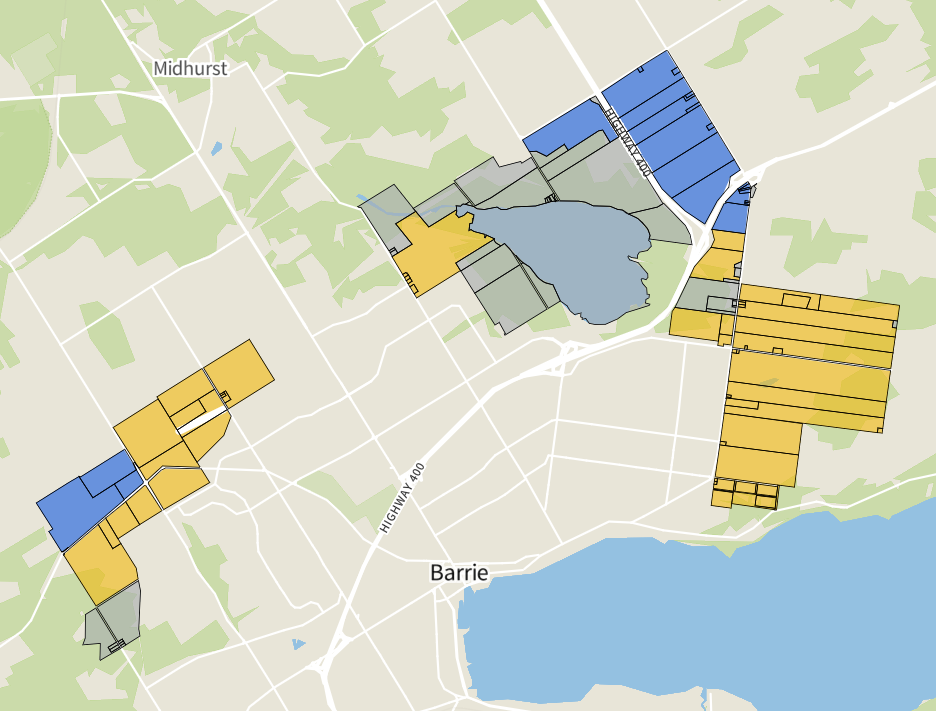
How Annexation Can Increase Land Value
The basic principle is simple: urban land usually has a higher value than rural land because it can support more intensive uses.
Rural or agricultural land is usually valued based on rural or agricultural use. Once land may support housing, employment, commercial, industrial or institutional development, the value can rise.
That increase often happens in stages.
- When growth pressure increases
- When a boundary change is discussed
- When annexation becomes likely
- When the boundary change is confirmed
- When servicing becomes possible
- When planning policies are updated
- When zoning changes are approved
- When subdivision or site plan approvals move forward
- When construction becomes realistic
Each stage can reduce uncertainty. Less uncertainty often means higher land value.
This is why developers and long-term investors watch planning changes closely. They are not only looking at what the land is today. They are looking at what the land may become.
What This Means for Investors
For investors, annexation is a planning signal, not a guarantee.
The opportunity may be real, but so is the risk.
A smart investor does not simply ask whether land will go up in value. They ask what has to happen for that value to be unlocked.
Important questions include:
- Is the land inside a confirmed growth area?
- Can it be serviced?
- What does the official plan allow?
- Is a zoning change required?
- Who owns the surrounding properties?
- Are developers assembling nearby land?
- Is the municipality supportive of growth?
- Are there environmental constraints?
- Are there road, traffic or infrastructure limitations?
- What is the realistic timeline?
- What are the carrying costs while waiting?
Investors can make mistakes when they chase headlines instead of fundamentals.
Land can look valuable on paper and still take years to become developable. Political direction can change. Servicing can be delayed. Interest rates can affect feasibility. Construction costs can shift. Community opposition can reshape proposals.
Good investors study the planning path, not just the purchase price.
What This Means for Homeowners
For homeowners near annexed land or future growth areas, the impact can be mixed.
Growth can bring new services, roads, amenities, jobs, housing options and commercial activity. It can also increase interest in nearby properties and improve the long-term profile of an area.
But growth can also bring disruption.
Residents may worry about traffic, construction, density, changing neighbourhood character, pressure on schools, loss of rural landscape, noise, environmental impact and affordability.
Both sides can be true.
Growth can create value, but it needs to be planned properly.
For homeowners thinking about selling, annexation or nearby development pressure may affect positioning. A property may appeal to more than a traditional residential buyer if it sits near future growth, servicing or land assembly activity.
For homeowners planning to stay, it is worth following planning notices, council agendas, servicing discussions and development applications.
The land around a property can affect both value and quality of life.
What This Means for Buyers
Buyers need to look beyond the house.
When buying near annexed lands, future growth areas or major development corridors, the question is not only whether the property works today. The question is what the surrounding area may become.
A quiet road today could be near future housing. A rural-feeling property may eventually sit close to commercial development. Vacant land nearby may become a subdivision, employment area, institutional site or mixed-use project.
That does not automatically make the purchase good or bad.
It means the buyer needs proper context.
A showing is not advice. A price is not a strategy. In growth areas, buyers need to understand land use, servicing, zoning, surrounding ownership and future development pressure.
The wrong property at the wrong price can become a problem. The right property with the right context can be a strategic decision.
What This Means for Residents
Residents are often the last to feel informed about major planning changes.
Developers, landowners, planners and municipalities may be watching an area for years before the broader community understands what is possible.
That can create frustration.
People may feel blindsided when land around them is suddenly discussed for development, even if the planning signals were visible for a long time.
This is why public participation has to be more than a formality.
Boundary changes, servicing agreements and major development proposals affect traffic, schools, parks, infrastructure, municipal taxes, housing supply, farmland, environmental features and community identity.
Residents deserve clear information and meaningful opportunities to participate before decisions feel finished.
At the same time, Barrie and Simcoe County face real housing and growth pressure. Families need places to live. Employers need workers. Municipalities need tax base. Communities need infrastructure. Young buyers need more realistic options.
The issue is not whether growth happens.
The issue is whether growth is planned responsibly.
Why the Bayfield Street Corridor Deserves Attention
 One of the most important pieces of the annexation story is that not all land expected to be developed was actually annexed.
Land on either side of Bayfield Street in Springwater, along the Barrie border, remains in Springwater. However, provincial direction has pointed toward Barrie and Springwater reaching an agreement for Barrie to provide cross-border servicing to those lands.
That is significant because cross-border servicing can allow development to move forward even when land remains outside Barrie’s municipal boundary.
For real estate, the map is not always as simple as “inside the city” or “outside the city.” Servicing agreements, provincial direction, planning approvals and municipal cooperation can all affect land value and development potential.
Buyers and investors need to understand the mechanics behind the boundary lines.
The Reported Bayfield Street Development Proposals
The Bayfield Street corridor is important because development may move forward there even though some lands were not included in the annexation.
Reported proposals include:
- 727 Bayfield Street North, owned by Lonybra Developments, with plans involving a pharmacy and medical office building, a community centre, a 51-unit palliative care hospice and a range of seniors housing.
- 742 Bayfield Street North, proposed to include approximately 2,000 residential units with dedicated seniors housing, plus mixed-use medical, commercial, retail and recreational spaces.
- 651 Bayfield Street North, reportedly purchased by Sean Mason for $3 million in 2023.
This is why growth planning cannot be understood by looking only at municipal boundaries.
Servicing, institutional uses, seniors housing, medical space and mixed-use development can all create value and change how a corridor functions.
What This Means for Housing Supply
Annexed land may eventually support more housing, but more land alone does not solve housing affordability.
Affordability depends on what gets built, how quickly it gets built and whether the housing mix meets real community needs.
A growth area may support:
- Detached homes
- Townhomes
- Semi-detached homes
- Low-rise housing
- Mid-rise housing
- Rental housing
- Seniors housing
- Affordable or attainable housing
- Mixed-use development
The public benefit is stronger when growth creates housing choice, not just more expensive ownership housing.
If newly developable land only produces high-priced homes, the affordability problem continues. If growth includes a better mix of housing, infrastructure, services, parks, employment access and transit planning, the community benefit becomes much stronger.
The land is only the beginning.
The planning decisions that follow determine whether growth serves the broader community or simply creates more expensive supply.
What This Means for Commercial and Employment Growth
Annexation is not only about residential development.
Developable employment land can support business parks, offices, industrial uses, medical services, retail, logistics, institutional expansion and local job creation.
A strong city cannot rely only on residential growth.
Housing without employment can increase commuter pressure. Employment without housing can create labour and affordability challenges.
Balanced growth needs both.
If annexed lands support employment uses, Barrie may strengthen its role as a regional economic centre. That can affect property values, business investment, traffic patterns, housing demand and commercial real estate activity.
For commercial investors and business owners, the key question is where future growth nodes may form and how access, servicing and population growth will support demand.
What This Means for Springwater and Oro-Medonte
When land is annexed from a township into a city, the township loses future control over that land.
That can affect planning authority, future tax base, development potential and local identity.
For residents in Springwater and Oro-Medonte, annexation can raise concerns about local voice, consultation and who gets to decide how nearby land grows.
Those concerns are valid.
Cities may argue they need land to support future housing, employment and infrastructure. Townships may argue they should retain control over their own planning future.
Both positions have real consequences.
For property owners, the result is practical: when the municipal context changes, the real estate conversation changes with it.
The Bigger Lesson: Follow the Land
The Barrie annexation story shows an important real estate principle.
By the time the general public is talking about a major land-use change, developers and strategic landowners may already have been watching for years.
They are often tracking:
- Municipal boundary changes
- Official plan updates
- Servicing capacity
- Population forecasts
- Employment land studies
- Provincial legislation
- Minister’s zoning orders
- Planning applications
- Transportation corridors
- Hospital, school or institutional expansion
- Major road and infrastructure plans
- Large land sales and corporate ownership changes
This may sound separate from everyday residential real estate, but it is not.
These decisions shape where homes get built, where roads expand, where businesses locate, where services are delivered, where tax dollars are spent and where value moves over time.
What Buyers, Sellers and Investors Should Watch
If you are watching Barrie, Springwater, Oro-Medonte or surrounding Simcoe County communities, pay attention to the next stages of growth.
Important signals include:
- New development applications
- Servicing agreements
- Zoning amendments
- Subdivision plans
- Employment land proposals
- Road and infrastructure planning
- Public consultation meetings
- Hospital and institutional land use
- Commercial development announcements
- Land sales and resale activity
- Changes to municipal planning documents
- Corporate ownership activity
- Properties marketed as investment or development land
Annexation is not the end of the story. It is the start of the next phase.
Why This Deserves Attention in Simcoe County
Simcoe County continues to face growth pressure from population movement, housing demand, affordability challenges, commuting patterns and investment activity.
Barrie remains one of the region’s most important urban centres. Springwater and Oro-Medonte continue to attract attention for lifestyle, land, proximity and long-term growth potential.
Boundary changes and servicing decisions influence where people live, where builders build, where investors focus and how municipalities prepare for growth.
For clients, this means real estate decisions should not be made in isolation.
The home matters. The price matters. The neighbourhood matters. But so do the planning decisions happening around it.
The Bottom Line
Barrie’s annexation of lands from Springwater and Oro-Medonte is one of the most important local examples of how planning decisions can affect real estate value.
It shows how land can shift from rural or township context into a city growth conversation. It shows how servicing changes value. It shows why developers watch early. It shows why residents need clear information. It shows why buyers and investors need more than surface-level advice.
The money trail is part of the story.
Reported purchases, listings and resale activity show how land can gain value when future development becomes more realistic. They also show why buyers, sellers, residents and investors need to understand what is happening behind the scenes before the neighbourhood around them changes.
Boundary changes, servicing, land assembly, corporate ownership and political decisions all influence where value moves.
In growth markets like Barrie and Simcoe County, people who understand those forces early are usually better prepared than people reacting after the signs go up.
Thinking About Buying, Selling or Investing?
If you are buying, selling or investing in Barrie, Springwater, Oro-Medonte or surrounding Simcoe County communities, this kind of market context should be part of the conversation.
The right real estate decision is not just about today’s listing price.
It is about land use, future growth, servicing, access, risk, timing and whether the property still makes sense as the area changes.
The MovingSimcoe.com Team helps clients look at real estate through that wider lens: practical, strategic and grounded in real life decisions.